
What Swimmers Need to Know About Using Paddles© Felix Gmünder |
Drills for developing a feel for the water and the optimal angle of attack
Sculling drills are demanding - if you do them right. And to do them perfectly is in our focus. Thus, short intervals, short distances, but perfect! For instance, perform drills using paddles fluidly over short laps such as 25 metres with a break in between (depending on your fitness level). As an example repeat 4 specific drills 4-8-times 25-50 metres. Limit your speed that you are able to perform the drill absolutely correct. 99% perfect is 100% imperfect. Overuse of paddles and wrong application may cause swimmer's shoulder.The advantage of this approach is:
- Correct technique, opportunity to concentrate on details
- Drill of technique, coordination and strength endurance up to competitive speed
- Last but not least: Your coach is able to give feedback every 25 metres. Every swimmer deserves a feedback!
There are 3 types of paddles
- Large paddles, overlapping the hand quite lot, some with holes, and elastic bands at fingers and wrist. They are not suited for sculling.
- Finger paddles (or half paddles) cover only the fingers and not the palm. Usually they only have one elastic string to fit one or 2 fingers.
- Paddles not larger than your hand. Ideally they have no elastic band to secure them but a central ridge to squeeze between the ring and middle finger.
Paddles 2) are O.K. paddles 3) are best. With this type of paddle you learn to keep them fixed to your palm using only hydrodynamic pressure (lift/drag). If you do not conform with the principles of hydrodynamic lift/drag, they simply fall off. In any case - even if you use strap-on paddles - don't grab them. Keep fingers relaxed [More on paddles in swimming].
How to use paddles?
Sculling Drills
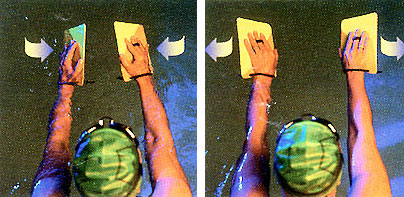
Start doing the drills in chest-deep water: Put your hands out in front of you (s. image to the left). Turn your palms in and sweep to the center beneath the surface. Then turn your palms out and sweep your hands and forearms out to the side (s. image to the right). How much you turn out (or in) your palms during the sweep is called the angle of attack. When you master this drill you continue with the following drills.Basic drill 1, stationary
Goal: Get a feeling for angle of attack and lift/drag. Hang vertically in the water (no standing, swim). With your hands just below the surface create a wide flat figure-8 pattern sweeping in and out in front of you. If you are really good at this you can strap some weight (2 to 8 kg, corresponding to 4 to 18 lb) around your ankles.Basic drill 2, stationary
- Goal: Get a feeling for angle of attack and lift/drag. Same position as #1. But in addition add the following:
- Sway your body to the side
- Sway your body backward and forward
- Create a circle with your feet
- With body at the surface, create a circle around your head (keep head in the center of the circle)
Basic drill 3, explore the role of the angle of attack
- Goal: Improve "feel" for the water: How does the position of your hands affect the hydrodynamic lift/drag?
- Lie on your back with your ears under the water. Place your hands at your sides, fingertips show ... to swim head in front.
- Lie on your back as before. To swim feet in front, your fingertips show ...
- Lie on your front and extend your arms forward over your head. Scull in a small outward circular motion with one hand at a time or with both. This is good practice for the catch of your pull in freestyle as well as in breaststroke and butterfly. Keep in mind, that overuse of paddles, in particular in this type of drill in the catch-position may cause swimmer's shoulder.
- Breathing when lying on your front: Lift your head quickly to inhale, otherwise look down vertically to the bottom of the pool.
- Legs: As a variation apply a gentle freestyle kick. As an exception, a pull buoy is perhaps helpful.
Role of sculling-speed
- Goal: Fast sculling by adapting the angle of attack of your hand very quickly produces enormous speed, although insweeps and outsweeps are small.
- Lie on your back, feet go in front. Arms over your head. Synchronised swimmers call this the torpedo-position. Bend your wrists so that fingertips show to the bottom. Good swimmers need less than 20 seconds for 25 metres.
Improve the catch and high elbow position
- Goal: After recovery, you have to find the catch and at the same time apply a high elbow position.
- Lie on your front, arms in front of you. Start sculling with only little pressure, but keep an eye on your high elbow (rotate arm internally). Pull until you reach the level of your shoulders with increasing pressure then recover arms under water in front of you and start over again.
Transition from pulling to propulsive phase (freestyle, butterfly, and backstroke)
- Goal: Perfect body balance and increase of pressure during the transition from pulling to propulsive phase.
- Lie on your front with arms at levels of your shoulders. Elbows close to the surface and let forearms hang down vertically. Scull with your forearms.
Completion of propulsive phase (freestyle, butterfly, and backstroke)
- Goal: Improve finish of propulsive phase.
- Lie on your front. Hands at hip-level (don't keep your arms straight). In this position start sculling.
Stroke drill
- Goal: Improve swimming technique and fine-coordination of stroke pattern at higher speed. Use small paddles only (just overlapping your palms)
- Short sprints only, 25 metres. Breaks between sprints 20 - 30 seconds. Concentrate on perfect technique not speed.