
What Swimmers Need to Know About the Choice and Purpose of Paddles© Felix Gmünder |
What are Paddles Good for?
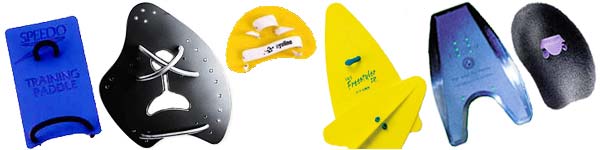
Paddles are used for the following:- Training aid to improve swimming technique
- Improvement of stamina and speed
- Sprint-Assisted Training
Training aid to improve swimming technique
The idea behind the use of hand paddles is to increase the surface area of your hands, thereby improving your feel for the water throughout the pull phase of your stroke. The paddle helps to experience the proper angle of attack during the individual phases of the armpull (key words: S-pulling pattern, insweep, outsweep, sculling). Paddles contribute substantially to neuromuscular learning, if applied properly. With repeated practice, your hands will make their adjustments naturally, even when you don't start first with paddles.Most hand paddles have wrist and finger straps to keep them in place. Many coaches recommend that you swim without the wrist strap, so you can sense the difference between proper and improper hand entry. With only the finger strap to keep them in place, paddles will wobble, even fall off, if your hand enters the water at the wrong angle.
Paddles that are more than slightly larger than your hands can be rough on your shoulders (shoulder pain in swimming).
Propulsion in swimming is produced by a combination of drag and lift at the hand and arm (we do not mention the role of kick and the effect of body long-axis and short axis rotation on propulsion). Paddles are an excellent means to experience and improve the angle of attack when doing sculling drills with your hands. Paddles much larger than your hand are less suited for doing this.
Do not use paddles to improve endurance. Hand paddles are meant to improve technique, stamina, and speed. Caution: Don't use paddles for more than 25 percent of your workout. If you use them too often and without surveillance by a coach they become a crutch for hiding flaws in your stroke rather than a tool for correcting those flaws.
With paddles as a method of sprint-assisted training (s. below), negative effects on coordination and intra-cyclic velocity have been discussed.
Improvement of stamina and speed
Large paddles make your hands larger and increase the amount of water resistance you must overcome. This is true if you don't evade resistance by increased "slippage". This exactly is the problem: You only have a training benefit if you can maintain the quality of biomechanical properties of your armpull. In reality few swimmers match this prerequisite, and only if the paddles are only slightly larger than their hands and for relatively short time intervals. As soon as you get tired, coordination degrades and swimming technique deteriorates. Furthermore flawed technique may lead to injury of the shoulder (often) and the elbow (more seldom).Tapered paddles, which are narrow at the fingertips and wider over the palm and wrist most probably put less stress on shoulders of freestylers (Richard Quick, personal communication).
Sprint-assisted training
According to Swimming Even Faster, by Ernest W. Maglischo one way to improve sprint speed is by increased resistance ("Sprint-Resisted Training", parachute, surgical tube) or by increasing propulsion with fins or hand paddles ("Sprint-Assisted Training). Sprint assisted training does not have the disadvantages of slow turnover rates and detrimental changes to stroke mechanics. Paddles make it possible to swim as fast or even faster as in a competition over short distances. However, Maglischo emphasises that "careful attention must be paid to the stroke rate [...] it should be at least equal to the competition rate."Maglischo prefers fins to paddles because there is no danger of injury. Richard Quick, personal communication) does not propagate paddles but tolerates their use if the swimmer insists. Richard Quick uses fins for sprint-assisted training and parachutes for sprint-resisted training. To prevent the parachutes from sinking a pull buoy is attached with a short rope.
Tips how to use paddles
In a nutshell, we recommend the following:- Preferably, use small paddles only slightly larger than the hand.
- Remove the rubber strap holding the paddles to your wrist - one strap around a finger is best.
- Build-up the use of paddles slowly over weeks.
- Put the emphasis on perfect stroke technique.
- Put paddles on after warm-up. Do not use paddles when you are tired.
- Limit the time using paddles to 25% of your workout.
The bigger the better?
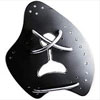
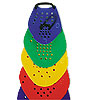
Manufacturers of large paddles aim at the market of people not so familiar with swimming, such as triathletes, fitness swimmers etc. These people think that swimming speed is mainly limited by strength and stamina. In fact, the larger the paddles the more strength you need but the more difficult it gets to maintain proper stroke mechanics. Even recovery becomes extremely problematic. Regardless of what the manufacturer tells you and the shape of the paddle, the danger of shoulder injury increases remarkably.The main reasons for this are:
- During recovery many swimmers with large paddles tend to rotate the upper arm internally. Internal rotation is when the palm is showing outwards with thumb backwards.
- The arm pull begins much too early before the hand sinks into the high elbow catch position.
- More about swimmers shoulder and paddles.
Finger paddles: Small is beautiful
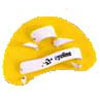
From the standpoint of maintaining stroke mechanics and turnover rate fingerpaddles are ideal and you still get the feeling for the angle of attack and water pressure on your palm.The only disadvantage is that they only cover your fingers. Thus they exert an extra stress on your fingers and the corresponding tendons attached to the inner side of your elbows. If you are sensitive and if your build-up is too quickly, the insertion of the tendons may get inflamed (tennis elbow of the good player). Stretching your finger muscles may help. With these paddles too remove the strap that fixes them to your palm.
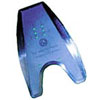
Fulcrum paddles prevent tendinitis
Fulcrum paddles were designed to prevent injury of shoulders and elbow. If the paddles are too large, however, you put a stress on your shoulders regardless of what the manufacturer claims. If you choose the right size they do not have any advantage over other paddles except that the force vector starts very close to the hinge of your wrist. This takes the stress from the tendons of your wrist and finger muscles.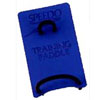
Classic and still classy
The Speedo Hand Paddle is one of the first, and still very useful. To further improve learning remove the rubber strap holding the paddles to your wrist (s. Speedo's Swimfoil).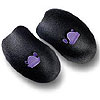
Technique aficionados go for swimfoil
Speedo's Swimfoil paddles are designed to enhance the hand's natural lift mechanics and aim to build up more efficient stroke technique. The first thing that you will notice is (usually) that in the beginning you get rid of them about every 10 meters at entry or pull out. The single rubber strap that attaches to your middle finger provides only little security. Excellent idea: Swimfoil teaches you efficiently to keep your hands at the right angle when reaching into and leaving the water (i.e. with little resistance).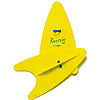
Freestylers love Finis
Finis are the only hand paddles specifically designed for freestyle swimming. Patented skeg technology will force the swimmer to maximize arm extension (with caution if paddles are too large) and initiate rotation at beginning of stroke.Finis paddles are tapered, i.e. narrow at the fingertips and wider over the palm and wrist and show the already mentioned "Fulcram-effect". These paddles put less stress on your shoulders (if the size is not too large).
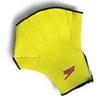
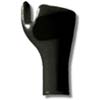
Gloves and "Fistglove®"
Gloves are sort of a toy for the competitive swimmer. There are no advantages as compared to paddles. On the contrary, stroke mechanics deteriorate.Fistglove® is an interesting means to foster stroke mechanics. The effect of fists is enhanced. You have no feel for the water and are forced to keep your fingers curled. Fistglove® helps the freestyler to initiate body rotation with a kick. It prevents you to lift your head and upper body for breathing because you have no support during the initial phase of the armpull. Rather you should let your hand sink into the catch and high elbow position.