
Swimmer's Shoulder: Prevention and Treatment© Felix Gmünder |
What causes swimmer’s shoulder?
Swimmer's shoulder, also known as shoulder impingement syndrome, is an overuse injury that causes inflammation or irritation of the rotator cuff muscles and tendons. It is triggered by repetitive overhead movements, fatigue, or incorrect swimming technique, and causes pain at the front or top of the shoulder, as well as a loss of strength.What can be done about it?
Possible measures for prevention and relief include:- Stretching exercises
- Strengthening exercises for the rotator cuff
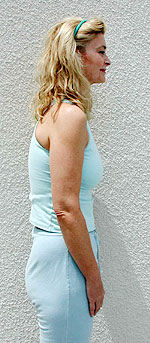
- Better posture (especially in everyday life!)
- Improved swimming technique: discussion of shoulder anatomy; paddles can be harmful
- If this does not help, it is advisable to seek advice from an orthopaedic surgeon or a sports physiotherapist who is familiar with swimmer’s shoulder.
Do some gentle stretching exercises
One cause of shoulder pain can be shortened muscles or muscles in the shoulder girdle that are not strong enough. So you need to stretch and strengthen – but do it properly. When it comes to stretching: too much is unhealthy. Stretch only the muscles, not the ligaments or the joint capsule; many of the established stretching exercises stretch the joint capsule too much, which compromises the stability of the shoulder joint: Stretching exercises for swimmers. The pectoralis muscle is particularly prone to shortening, which contributes to the typical poor posture seen in many swimmers.Strengthen the rotator cuff muscles
Strengthening: Particular emphasis must be placed on strengthening the rotator cuff muscles and the scapular muscles, as this helps, amongst other things, to stabilise the shoulder joint: Selection of exercises (PDF file). It works with light dumbbells or a Theraband. Ask a physiotherapist to show you how to use it properly.Improve your posture
| Characteristics of poor posture: |
|
 |
|
| Characteristics of good posture: | |
 |
|
Good posture helps to prevent shoulder problems; furthermore, the more streamlined body position reduces water resistance.
Improve your swimming technique; be careful with paddles!
Shoulder injuries are most commonly observed in front crawl and butterfly swimming, and in most cases they also arise from these two strokes. Backstroke and breaststroke are less frequently the underlying cause. In 90 per cent of cases involving front crawl and butterfly, so-called ‘impingement’ is the cause of shoulder pain. In impingement, the head of the humerus has room to move upwards and, in doing so, causes the supraspinatus tendon of the rotator cuff to strike the acromion and the coracoacromial ligament (see anatomical diagram top right). This occurs in:- hypermobile shoulders, and
- during the recovery phase of the arm and when reaching for the water
If you have ever had shoulder problems, or to prevent them, check your swimming technique/mechanics using this list and, if any of the points apply, try to improve your technique:
- Avoid internal rotation of the hand, forearm and upper arm, particularly during the forward recovery and when catching the water. Internal rotation means the palm faces outwards, with the thumb pointing backwards. Instead, the palm should face inwards with the thumb pointing forwards and the little finger at the back (rotate the arm clockwise).
- High, bent elbow during the forward pull; arm never fully extended.
- The Stanford University team (Head Coach Richard Quick) successfully employs a different approach: swinging the arms forward in a relaxed, extended manner (ballistically) whilst simultaneously rolling the body, so that the arms can be brought forward beyond the level of the shoulder blades. In the butterfly stroke, too, the arms are brought back in front of the shoulder blade plane. Head position is always low in both strokes (personal communication from Milt Nelms).
- Check whether entering the water slightly wider than shoulder width is beneficial (11 o’clock and 1 o’clock positions), almost as in the butterfly.
- After entry and whilst catching the water, never extend the arm forwards to the full extent of the elbow joint (Thorpe does this, but Van den Hoogenband does not. For Thorpe, this probably works without any problems because his leg kick bridges this phase of catching the water until the force is applied.
- Do not apply any downward or backward force whilst catching the water until the forearm has dropped sufficiently deep into the high elbow position.
- No paddles. The problem with paddles is that you tend to start pulling too early, because it takes longer for the hand to drop deep enough to catch the water. This pushes the humeral head upwards. Furthermore, paddles ‘force’ most people to bring their arm forwards in internal rotation – particularly when the body is not rolled over enough.
- Avoid deliberately extending the arm or making a final push at the end of the drive phase. Instead, try to round off the drive phase with a slightly bent elbow and the hand and arm beginning to externally rotate (like Thorpe). Paddles often exacerbate this problem.
- Try not swimming butterfly for a while.
- When swimming backstroke, lead your arm forwards with your thumb first, not with your little finger as the textbook says; turn your arm inwards just before it enters the water.
- Avoid internal rotation wherever possible, for example at the turn or during leg kick exercises on your side.
- Keep your head low (looking at the bottom of the pool; practically nothing of your head should be above the water); do not turn or lift your head to breathe, but roll with your body [More on efficient front crawl swimming].
Anatomy of the shoulder joint
‘Swimmer’s shoulder’ is a collective term for a wide range of problems affecting the muscles and tendons of the rotator cuff (see images), as well as various ligaments, the bursa and the bones of the shoulder joint:- The four muscles of the rotator cuff: Musculus supraspinatus, Musculus infraspinatus, Musculus teres minor and Musculus subscapularis
- Shoulder socket or glenoid with joint capsule – head of the humerus
- external clavicular joint or acromioclavicular joint with ligament
- coracoacromial ligament
- bursa beneath the acromion and coracoacromial ligament
- Biceps tendon
- Supraspinatus tendon (below the bursa)
Rotator cuff injuries are relatively common, not only amongst swimmers. The general symptoms include pain or difficulty in raising the arm. Many people are unable to lie on the affected shoulder and wake up at night in pain. A lack of strength is also noticeable when lifting objects.
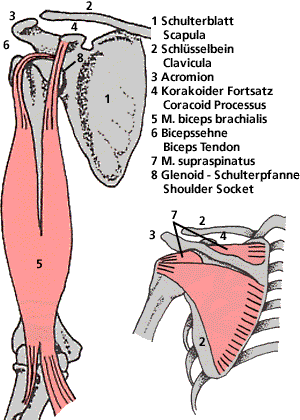
Bones and muscles of the shoulder girdle viewed from the front (left image) and from the back (right image). The bursa is located beneath the acromion and the coracoacromial ligament. The infraspinatus muscle and tendon pass between the bursa and the head of the humerus.
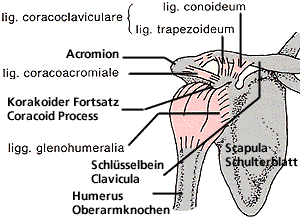
Bones, joint capsule and ligaments of the shoulder girdle, viewed from the front.