What Swimmers Need to Know About Fins© Felix Gmünder |
There are three main reasons to swim with fins
- They create additional drag, meaning you have to work harder and it helps you consolidate the correct leg kick technique. The longer the fin blade, the more drag it creates, but the harder it is to maintain the correct leg kick technique (kicking from the hips, no ‘cycling movements’).
- Secondly, the increased surface area provides extra propulsion. This is utilised in what is known as ‘sprint-assisted training’, i.e. sprints at increased speed.
- Thirdly, fins are used to learn and practise the undulating motion in breaststroke and butterfly. Use specialised fins for swimming training.
Use specialised fins for swimming training
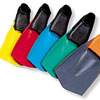
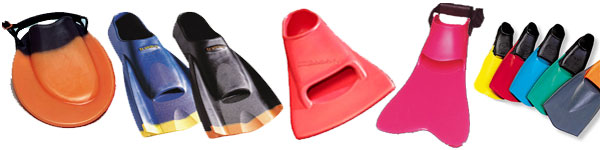
Fins used to be made of rubber. Today, they are made of compressed, heat-treated polyurethane or, better still, silicone, which lasts a lifetime.You can choose between short training fins with a blade length of 5–10 cm and standard fins (the blade is at least as long as your foot). Standard fins are only suitable for butterfly and for learning the undulating movement in breaststroke. Short fins are best suited for front crawl and backstroke because they allow for a normal leg kick rhythm. Of course, they can just as easily be used for butterfly or when learning the wave-like body movement [Exercise for learning the undulating swimming technique].
Do not use hard, stiff fins, or any that are wider than 1.5 times the width of your foot, or whose blade is longer than your foot.br>
How to use fins
Fins extend your foot and leg, making your kick more efficient and speedier.In fact, using fins in sprint training helps you to keep your body in a more slippery position [more on "Sprint-Assisted Training"]. In addition, you will experience that a good kick pays off a lot. But: Some swimmers are not aware that they bend their knees to much. In fact, they initiate their kick out of their knees instead of their hips. In addition, most swimmers rely on their downbeat as if they want to kick a ball. There is an upbeat too that contributes to propulsion? Food for thought!
When you decide to put on fins start slowly and let your muscles time to adapt. Some swimmers experience cramps in the calves [What to do against cramps]
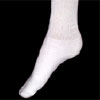
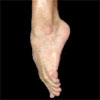
Fins help to increase foot flexibility (plantar flexion).
If your foot flexibility is as good or worse as shown to the left, your kick and whole stroke swimming can be improved greatly by improving flexibility. Fins are one means to achieve that. Specific stretching exercises help even more. Stretch your foot (plantar flexion) for at least 2 minutes several times per day. Don't use stretching positions with your knees bent less than 90°, e.g. by sitting on your heels. Rather tug your feet under a (heavy) cushion of a sofa in front of you when reading a swimming magazine. Otherwise you will damage your knee joints in the long run. If it hurts you stretch too hard.Many elite swimmers have a very efficient leg kick – partly because of the flexibility in their feet (hyperextension).
Fins Enhance your Fitness
Fitness Swimming. Fins are great fun. Thus, they are an ideal training aid in fitness swimming. Even slower swimmers can get addicted to swimming really fast. Fins are much better than paddles. Paddles can cause shoulder pain if you are not well trained or your technique is poor. Fins allow you to increase leg strength, stamina, and endurance, and activate more muscle mass in swimming. This is of interest for the fitness swimmer who wants to stay fit or shed off a few pounds. Try Emmett Hines's book "Fitness Swimming" to learn more about this topic.Our buying recommendations