
Learn and Practise the Wave-Like Swimming Techniques© Felix Gmünder |
How do you swim breaststroke and butterfly these days?
Modern Breaststroke and Butterfly swimming are based on the wave-like motion of your body - similar to what dolphins and whales are doing. In contrast to freestyle and backstroke swimming, this motion is also called short-axis rotation since the body rotates around an axis going sideways through the hips. The following drill is designed to help you to grasp the idea of the wavelike motion. Note that in the two strokes kick and armpull have to be "added" to the core body pulse in different ways: It is important to realise that the "big co-ordinator" of the whole stroke is the core body pulse, not kick or armpull.In breaststroke and butterfly, the rhythmic undulation of your torso drives your arms and legs. Novices in breaststroke and fly who are not familiar with this aspect are not aware of this and try it the other way around, with little success (they butterstruggle lap for lap). It generates power and sets your breathing rhythm. You'll swim both strokes better and faster by moving your core - not your arms and legs - better and then faster. Thus the starting point for improving both breaststroke and butterfly is mastering short-axis rotation. And the best way to do that is with the following dolphin drill. Tip: As with all drills in swimming it is recommended to do them with a coach, friend or other person who is familiar with the idea of the drill. The reason is: You need feedback. Even excellent sportsmen and -women need feedback, because nobody is able to really know if what he or she is doing is really identical with that what it looks like. That's why in ballet they exercise in front of a mirror
Through the motion
Lie on your stomach with your arms at your sides - relaxed. Press your chest into the water gently and rhythmically, and let your body react. Practice short repeats - 10 or 12 presses - without breathing in chest-deep water. Create a rhythmic wave that's gentle and relaxed. Move as quietly as you can.Take it on the chin. Use your head to channel your energy forward. Each time you press your chest downward, relax your chin: Let your nose move forward (not downward) with each chest press. This sends a wave action rippling down your body. If you do it right, your head will barely submerge. Feel each press move the crown of your head toward the end of the pool.
Loosen your legs. Now let's address the biggest foe of learning wavelike motion: Kick. Keep your legs supple and relaxed. Let them move with the undulation of your torso by not kicking them deliberately. Don't use your thigh muscles at all. Your legs should be an extension of your body wave, which begins at your head and travels out through your toes. It's not important that you move forward at this stage of learning - you will make progress when practising (a lot). To overcome frustration use fins, but just don't kick!
Breathe easy. As you get more relaxed and the dolphin movement feels natural, try fitting in the breathing. At first, breathe every six to eight presses, then every two to three. Keep your head as close to a neutral position as possible. Avoid jutting your chin. If you hold your head right, you'll be looking down slightly as you breathe. Your head moves forward just over the surface and continues through the wave in one seamless motion. This breathing skill is helpful when doing full-stroke breaststroke and butterfly.
Do it in your sleep. Keep practising until all of this becomes second nature. Return to the dolphin drill regularly to get back in touch with relaxed core-body rhythms.
What does this wave-like body movement look like?
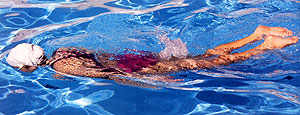 1 Exercise the press
Lie face down in the water with your arms at your sides. Press your chest up and down in the water as gently and rhythmically as you can.
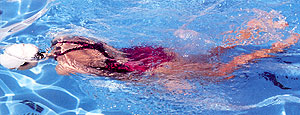 2 Head on
As you press your chest down, your head shouldn't go too far below the surface. With each press, you should feel the crown of your head move toward the end of the pool.
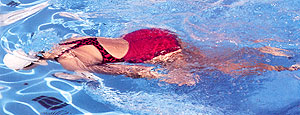 3 Check your chin
Keep your chin relaxed. Let your nose move forward slightly (!) with each chest press. Your buttocks come clear of the water.
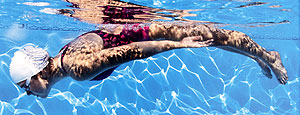 4 Loosen your legs
Relax your legs and try not to kick them. They are an extension of your body wave. Most people kick because they are used to or because they want to swim fast. Thus, wear fins. They can help you pick up the harmonic wave from your torso.
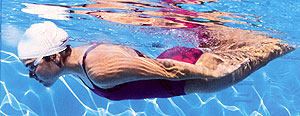 5 Release the press
After each press, release and move forward toward the surface.
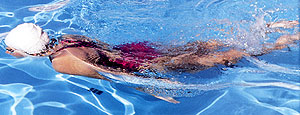 6 Neutralposition
Bevor du atmest, ist der Kopf in verlängerung der Wirbelsäule.
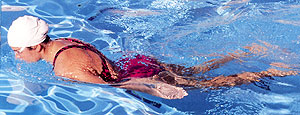 7 Breathing: Keep your chin in
This is the position to breathe. The first attempts (or many many) are really hard. You have to go through it. You should be looking down slightly when you breathe. You will probably swallow lots of water ... to be paid at the cashier ;-D