Learn Breaststroke Swimming with a Basic Drill for Novices© Felix Gmünder |
The breaststroke is technically demanding
Breaststroke is technically the most difficult swimming stroke - with no other stroke you see so much variation between swimmers. The key element of good breaststroke swimming is based on the principle of short axis rotation: Pulsing motion with your chest, similar to what you see with butterfly swimming: Drill to learn wavelike swimming (breastroke, butterfly)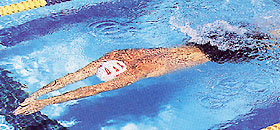
1. Start as a torpedo
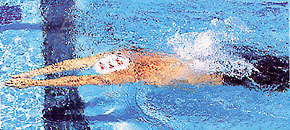
Keep your body long and streamlined to increase your gliding speed and cover more distance. Good breaststroke swimmers stay streamlined to push themselves through the smallest possible ‘gap’ in the water. As you glide in this position, lean forward onto your chest until you feel as though you are gliding ‘downhill’. This helps to keep your legs afloat (centre of gravity above the centre of buoyancy). Your outstretched arms should be just below the surface of the water. This helps you to engage your hips so that they are ready to swing forwards during the short-axis body rotation, which generates the power that drives your swimming stroke.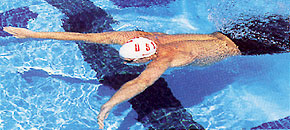
2. Press to a Y
Never pull your arms back in breaststroke. Virtually every inch of your pull is sculling movements (outsweep-insweep-motion of hands and forearms, and mind the angle of attack of your palm).After completing your extension and glide, continue to lean on your chest and elevate your hips while sweeping your hands out to a Y position. Don't apply too much pressure here. Scull as if your hand, wrist, and forearm were a blade. Try to anchor your hands in the water - as if there were a rung to grab - and draw your body toward your hands. Again, concentrate on keeping your head in line with your spine.
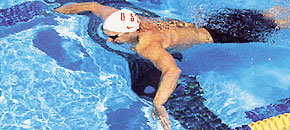
3. Spin your hands in
As your hands reach the Y position, lift your elbows toward the surface. Your elbows should stay at the eye line. If you use your high elbows as a hinge for the inward sweep of your hands and forearms, you'll create the leverage you need to use your abdominal muscles to bring your hips forward. Once you begin the in sweep, scull your hands directly back toward the front. When you do it properly, your hands complete all their sweeps in front of your chin. In phase 4, the fingertips point in the forward direction. Many good breaststroke swimmers try to keep their hands as far forward as possible; they feel that most people pull them too far back.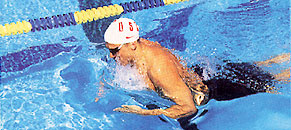
4. Breathe with body lift
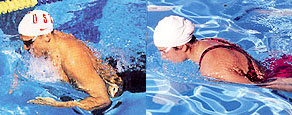
Do not lift your head to breathe (no nodding movements). Your head should always remain in the same position relative to your spine. As your hands and forearms sweep inwards, your shoulders are raised upwards and forwards – a slight ‘shrug’ – and this, together with the movement of your torso (tilting your hips forwards), brings your mouth completely out of the water.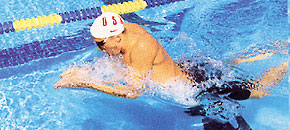
5. Begin the lunge
Your head has reached its highest point, and you're still looking down. Your arms are finishing the inscull by squeezing into a compact line. Your hips are also at their best point for using them as a platform to launch your upper body forward as you kick. In the wake of your body start to bring the heels close to your buttocks. Don't bend your hips, only your knees [more on breastroke kick]. Think of your body as a bow and arrow. "Your body becomes a bow that stores energy in your hips; in the next moment it becomes an arrow as you dive forward and release the energy from the shoulder end." Keep a low, narrow profile as you get set to dive forward.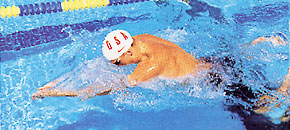
6. Dive forward
This is where you maximize your stroke length. The angle of re-entry is critical to creating the greatest possible wave length. Keep your head and shoulders hunched low as you finish your insweep, so your angle of re-entry is shallow, causing your momentum to channel forward. Return your hands to their full extension before your face re-enters the water, and make sure the crown of your head follows your fingertips forward.The dive is supported by the kick: The knees are not wider than the hips. Before you start the kick with a whip like motion of your lower part of the leg flex your feet and turn them to the outside.
The potential energy created by lifting so much of your body mass above the water on the insweep is converted into kinetic energy going forward. If your hands stall under your chin, or if you aim downwards instead of forwards, you'll sink instead of driving forward.