
How Do You Swim the Backstroke?© Felix Gmünder |
Tips for learning the backstroke
Why do elite swimmers swim so fast on their backs? Is it because they have a powerful arm stroke and leg kick? Of course, that counts too. Otherwise, they wouldn’t be among the world’s best. However, the decisive factor isn’t the powerful arm strokes and leg kicks, but rather that their bodies are exceptionally streamlined. Their bodies offer very little resistance to the water. How do they achieve this? Let’s take a look at how they lie in the water:1. Key element:
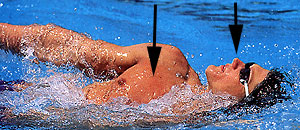
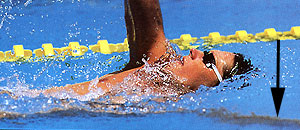
They keep their head deep in the water, their face parallel to the water’s surface. Their nose always points straight upwards (picture on the left, arrow). Their forehead and chin form a horizontal line. They never tuck their chin in. They lean their upper body backwards into the water. Their head and body position mean that their hip is practically at the water’s surface. Their body is straight and elongated. Viewed from the front (from the direction of swimming), the silhouette of their body is minimal, meaning that water resistance is also minimal.2. Key element:
They roll their bodies from side to side and almost never lie on their ‘back’ – this is merely a transitional position. In the left-hand image, they are lying completely on their left side. The right shoulder and chest are facing upwards or out of the water (arrow). This further reduces water resistance: in a stretched side position, with the lower arm extended forwards (or upwards, from the swimmer’s perspective), the human body offers the least resistance when performing arm strokes, as in the front crawl or backstroke. Many people have a tendency to swim “Front Quadrant Swimming” on their back. Their left arm is still in front (above the head) when they pull their right arm over their head (right, arrow).The momentum for the rotational movement does not come from the arm stroke, but from the kick and the hips. The trigger is the leg kick, once the returning arm has left the water (roughly at the moment shown in picture 1). Some describe it like this: “I try to rotate my hips completely out of the water with every body turn”.
How do you learn this backstroke technique?
How do we start? First learn proper body position in the water: Practise first on your tummy and your back -> [Body Balance] and [Basic Drills Balance and Buoyancy]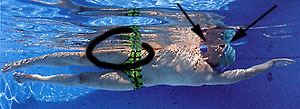 When you master balance on your front and your back start kicking on your left side. Hide your head lean into the water. The water line is at your chin and forehead. The left arm is stretched out in front of you. The gap between arm and hind of your head is ideally nonexistent or small. The hips are clear of the water, the right arm trailing on your side starts to feel cold... For a beginning fins are O.K. This basic exercise needs patience: Some practise for weeks until they master it. Ask somebody to observe you from above and underwater to give you feedback. Otherwise you start to internalise mistakes.
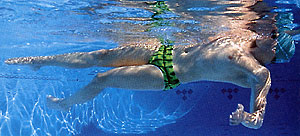 Start recovering your right arm. Initiate body rotation with a kick of your right leg, rotate your hips. Start stroking with your left arm.
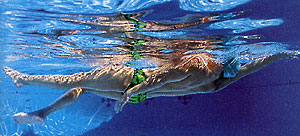 Your body has almost rolled to the right side. lean into the water - nose up - hips clear of the water.
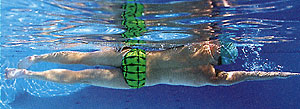 When the rotation is finished stay on your right side for several kicks and check your balance: Head - upper body - hips. Add some variation by exercising the same for freestyle -> Efficient Freestyle Swimming.