
Channel Swimming: A Personal Account by Roberta Bernet&© Roberta Bernet |
How it all began
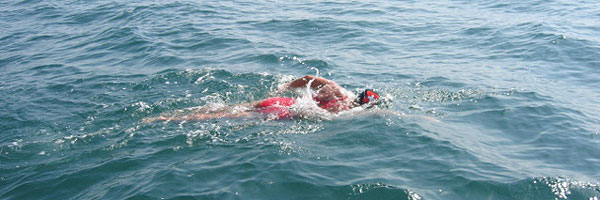
n 21 July 2006 Roberta Bernet (40) of the Aquatic Masters Team Zurich has conquered the English Channel (35 km/21 miles) in 9 hours and 55 minutes: an extraordinary accomplishment! We have asked her to share with us how she planned and experienced her success.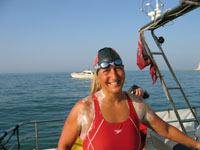
1. What made you decide to swim across the Channel?
It all started with the open water swimming booklet that was placed in my hand by a SLRG colleague who said, "Roberta - this is something for you". Among the countless swims through the scenic Swiss lakes and rivers, I saw the Sri Chinmoy swim (26.4 km), and I wondered, who would do such a thing? I never thought that I would ever be capable of doing something like THAT. In 1994, my Masters team sent four teams of three to that competition and a friend of ours (Jimmy Furrer) swam that race solo that year. Then I thought... one day... one day I would like to try it alone, but first there were many exciting Masters competitions to go to: European Championships, World Championships, World Masters Games, a short four year stay in the States and after that came the birth of my daughter Laura. Even though I wasn't swimming after Laura was born, I had at one point announced that I would try to swim that race alone, and after she was born, I would do it before she turned five! In 2003, I came back to swimming and started to train specifically for a Rapperswil-Zürich solo, not knowing if I could even make it. I had never swum for more than 2 hours in a row before in my life! But I did make it (8 hrs. 9 Min.) and at that race I met up with the other swimmers and got into a conversation about the English Channel. One swimmer, a Swiss woman, who has swum the Channel five times, said that Lake Zürich is a lamb compared to the English Channel. But the other swimmer, an Englishman who has swum the Channel twice, said he thought that I had a pretty good chance to make it across. And then this got me thinking...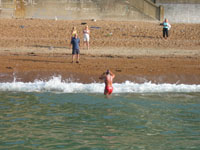
2. Was it a quick decision like betting with someone or more like a process with periods of doubts?
It was not a quick decision. First I looked on the internet for information about swimming the Channel and got quickly confused with the two organizations, which escort swimmers across, and I didn't really find any practical information about how to train for such a swim. But I have a friend from NY who swam the Channel in 2001 and when saw her over the holidays she hooked me up with a Channel Chat Group. I listened along for about 8 months and then after the Channel season started, and the updates were coming through about who was in the Channel that day and had they reached the separation zone, I was so hooked that I kept checking back on my computer to see if that person eventually did make it to France. In August 2004, I drafted a mail to my friend's pilot and after three days I finally clicked "send".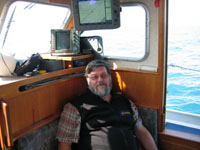
3. How long did it take you to prepare for the Channel swim?
I purposely planned the swim two years in advance. For one, all the good spots on the 2005 tides were already taken. I wanted to be either the first or second swimmer on my pilot's list. I also knew that I needed to gather experience.How many km did you work out during this time (per week average)? Did you have something like a training program to get used to long distance swims?
In 2005 I did the following swims to prepare myself:- 12 Hour swim in Hallenbad City in March. I knew that I would have at least 12 hours to swim the 35 kms from England to France and I wanted to see if I could even do this. To train for this, I swam my normal AMT (Aquatic Masters Team) workouts but added time on my own either before or after the official training.
- Through the Chat group I was able to get on an all-women 2-way English Channel relay. This relay would give me that chance to see the Channel but not have to swim the whole thing by myself. And since it was a double we would swim through the night and this would give me the opportunity to do a night swim. In order to train for this I started to go in the lake as of May to get used to the cold water. In the beginning I arranged for a boat to accompany me, since I didn't know how I would react to being in the cold water for an extended period of time. I started slowly, the first swim was just 15 minutes and I built up to about 2 hours in 15-16 degree water. When I went to England for the relay I trained in Dover Harbor (English Channel conditions) and after the relay I did a 6 hour qualifying swim for the following year.
- I came home after the relay and did another Rapperswil-Zürich solo. I wanted to practice feeding again, and I also did the Boston Light Swim (15km), which is in conditions similar to those in the Channel.
- I stayed in the lake as long as I could (last swim was in November 2005). Then I switched back to the pool.
In 2006, I did the following to prepare myself:
- I trained again for the 12 hour swim in March and because of this I built up the kms until then, then took a bit of a break, and then started again with the km build up in May again when I also started to go back in the lake.
- In Zürich I swam in the Zürichsee (until it got too warm) and then in the Sihlsee and the Wägitalersee. Here we also did some longer swims - up to 5 hours.
- I also went to Dover for two training weekends. One at the beginning of June (water temp 12 degrees) and one at the beginning of July (water temp 15 degrees). I did long back to back swims. In June on Saturday and Sunday, each 4 hours, and in July on Saturday a 7 hour swim and on Sunday a 6 hour swim.
The monthly km totals look like this:
- Nov 2005: 65100%
- Dec 2005: 99600
- Jan 2006: 105600
- Feb 2006: 129400
- Mar 2006: 107100
- Apr 2006: 78150
- May 2006: 113900
- Jun 2006: 153000
- Jul 2006: 176700
As for getting used to the long swims, I tried again to swim at least 5 kms before our normal training session (sometimes more) and then add on the training (4kms) and then maybe just rounding out the accounting to an even number (10 km, 11 km, etc.). I did this maybe once or a week in 2005 and about twice a week in 2006.
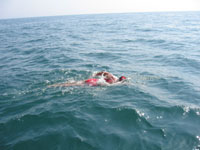
4. Were you supported by family, friends, other swimmers? Did you train by yourself or with other swimmers?
Of course I had the full support of my AMT teammates! My family understood what I was doing and also supported this. Since we have a young daughter, and I wanted to train with our team on the weekend, one day my husband would look after her and the other day we arranged for a babysitter. The first year I did do most of the training by myself but as of August 2005, I met Toni Pavicic (who was also training for an English Channel solo in 2006) and we swam together from then on. Naturally he swam more than I and faster than I but it worked out in the end without any problems.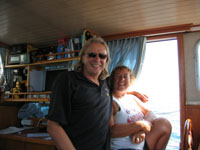
5. What were the major obstacles in getting physically and mentally fit enough? Was the problem mileage? Temperature? Swimming by yourself?
I think the major obstacle for me was finding the time to swim. The first year was not so dramatic since I was only training for the relay but as of 2006 I really had to do some organizing to fit the training in with my other life. My daughter was in Kindergarten and so came home for lunch every day (this is exactly when my Masters team trains). At one point 2 other mothers and I organized a lunch table for Thursdays (when the girls had to go back to school for an afternoon session) and so for two Thursdays I could swim with the team, and the third I had the girls for lunch. Otherwise I could only swim on the weekends. Then when May came around I swam almost every morning in the lake while Laura was at Kindergarten. I came home, warmed up, and then made lunch. Housework came later...
The cold does take some getting used to and the fact that I acclimatized slowly over two years also helped. I seemed to have an easier time in the cold the second year than the first. But for me it was never really an obstacle; I found it quite fun and since the goal at the end was so sweet, it was all worth it.
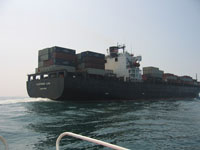
6. Have you prepared mentally too, if yes how? Was it more a physical or mental challenge for you, or both?
The English Channel is definitely a physical swim. One has to be able to swim 35 kms comfortably. But it is also a mental challenge as well. There are a lot of uncertainties with the Channel: when you will swim, what kind of weather you will have, how will you cope with what gets thrown at you, and will you be able to "hang in there" when you need to. For me, it was all about gaining confidence. And step by step - starting with that first Rapperswil-Zürich swim in 2003, I gained experience and confidence.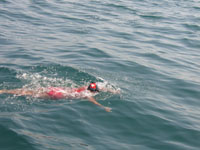
7. Is nutrition during the swim an essential element and how did you find out what is best for your digestive system? What exactly did you eat and drink the days before the swim, the 24 hours before the start and during the swim?
Nutrition is not really my strongpoint, but the nutrition during the swim is very important - it makes or breaks the swim.The Channel swimmers train with Maxim, a tasteless carbo loader that can be added to anything and the dosage can be adjusted according to the needs. This is what experienced Channel swimmers use and so this is what I went with. I trained with it (in the 2005 Rapperswil-Zürich race, in the 2006 12 hour swim, in my Dover training sessions) and learned what was best for my stomach. I've been almost sick on too high of a dosage of electrolytes, been constipated on too high of a dosage of Maxim Original. All this I learned during the course of the long swims.
I didn't change my diet too much before the swim. My daughter and I were staying in a camper outside of Dover and so we ate what we normally eat: pasta, rice, spätzli, vegetables, some chicken.
I don't remember what I ate the night before the swim - probably pasta.
I can't remember what I had for breakfast - most likely I had some coffee or tea, and maybe some oatmeal.
During the swim I predominately drank at each feed. I did have two Cadbury Swiss chocolate rolls but eating these made my feeds go up to a minute (as opposed to 20 - 30 seconds) and the taste in my mouth wasn't so bad that I felt I needed to eat to get rid of the salt water taste.
8. Most Channel swimmers have a high body mass index. Is it essential to have fat reserves and if yes why?
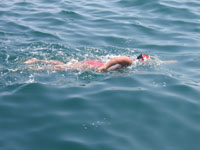
It is essential to have some fat reserves but it is also important to be fit and not fat. Although fat does keep you warm, the fatter you are, the more baggage you will have to pull through the water. The absolute best way to protect yourself against the cold water is to train in the cold. The body will build it's own layer of fat under the skin and this will keep you warm.9. What was the longest swim before your Channel swim? What the lowest temperature? Did you train in cold water a lot?
My longest swim was the 12 hour swim.The lowest temperature was 6.5 degrees (on my 40th birthday) but I only stayed in for one minute. It really only makes sense to start to go in the water at about the 10 degree mark. I built up from there so that at about 12 degrees I could start to do some longer swims (2 - 4 hours), at 15 degrees I can do my qualifying swims (back-to-back 7 hr/6 hr), and so that at 16 degrees (what I was hoping for) I could stay in for the duration. I did train in the cold water quite a bit. Of the 31 days in May I went in the lake 22 times.
10. Are there any tests you have to take before you can cross the Channel?
One has to prove that he/she has swum for 6 hours in 16 degrees or less. This can be in a river, a lake or the ocean, it must not be in Dover Harbor. I feel, however, it is better to have done this in Dover where the conditions are like to those in the Channel.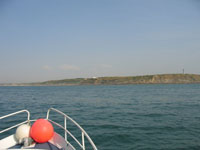
11. Where do swimmers get the information they need for preparation, exchanging experiences, finding fellow swimmers, entering for the event, finding a boat?
Websites:
- channelswimmingassociation.com
- channelswimming.net
- channelswimming.com
- Langstreckenschwimmen: Vorbereitung und Tipps
The first two websites will give information about getting in touch with the CS & PF, one of the two organizations that escorts people across the Channel. (The other organizsation, the CSA, can be found under www.channelswimmingassociation.com). One first reserves a pilot boat for a certain tide (the pilot will tell you what he has available), then fills out the necessary administrative forms with CS & PF.
The third website is a site for the swimmers and has a link to ask to be included in the Channel chat group. Here one can hook up with the other swimmers, listen to the advice that gets asked over and over again (there is also a search button and one can look in the history for past discussions about topics of interest to you).
12. Did you have times when you were thinking of dropping the project and if yes, how did you come over this?
No, I never thought this. I spent a lot of time and energy and didn't want it to go to waste.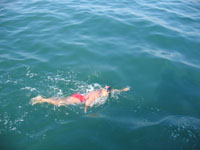
13. Have you had a crisis during the swim? How did you succeed? Were you always focused or did you have periods of memory lapses during the swim? Any day dreaming? If yes, is it negative?
I never had any crisis during the swim, well ok, one inconvenience. At one point the fumes of the boat were blowing into my face and they were making me sick. I had two options. One I could have asked to change sides of the boat. The other option, the one that I chose, was that I swam a bit further out from the boat and then fed as quickly as possible to get back away from the fumes.I was definitely very focused during the swim on swimming from feed to feed. I did think about many things (how the sunrays make zebra stripes in the water, observing the plankton, thinking about motivational sayings, watching the people on the boat and what they were doing, thinking about family and friends, etc.). but mostly I remember enjoying myself and having a great time!
Day dreaming is fine during a training session, but I felt that this was the real thing and I didn't want to miss anything! Often when people think of negative thoughts during training, it is best to re-focus on something nice - like daydreaming - perhaps of what it would be like to crawl out on a French beach and have to your family take you into their arms).
14. What were your thoughts at the start, at the finish?
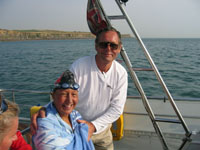
At the start, I wasn't nervous at all; it did go by fairly quickly though. I jumped off the boat, swam the 25 meters into Shakespeare Beach in Dover. I got a hug from my friend Barrie who came to see me and the others off. I dove in, got water in my goggles, stood up - readjusted them and then found my place next to my boat, Gallivant.I remember when my captain told me that if I could give him 30 minutes hard (this is about 8 hours into the swim), then we would be on the right side of the tide and I would be close to the time of my sister who swam the Channel in 1982. And then my supporter Cliff (that same Englishman from 2003) said that I would have only one more feed after that. At that last feed, I saw Cap Gris Nez for the first time. The last 45 +? minutes FLEW by. I couldn't believe that we were already almost in France. When I saw the boat drive away and drop Cliff off at the point, I saw big rocks underneath me and at first I was so excited but then I remembered to concentrate on maybe not scraping my body on them. And then all of a sudden I was behind Cliff who was scrambling to get out of the water. He said to me: "Put one foot here, the other one there, now stand up, turn around and wave". I did this, waved to the boat, and they sounded the horn. I think I asked Cliff if I was done, and when he gave me a hug I knew that it was over, and that I had swum to France. I was too tired to kiss any rocks, too tired to put my hands in the air, too tired to cry, but actually not too tired to continue swimming.
15. How important was the skipper and the escorting people on the boat?
One cannot swim the Channel alone. One needs the experience of the pilot AND one needs a support crew on the boat who knows what they are doing.First the pilot. His number one, two and three jobs are your safety. It is important to let him know (realistically) how fast you are over the long swim. Based on this information, he knows when is the best time to start. I've met four of the six CS & PF pilots. I have my personal favorites for one reason or another but they are all very good at what they do. I think it is quite difficult to make a decision without knowing the people personally. Some smoke, some not. Some goof around on the boat a bit, some are all business. Some interact with the swimmer (in various tones of voices) and others never say a word to the swimmer during the swim. It is a matter of what you feel comfortable with.
Second your support crew. Since nutrition was not my strong point, I needed somebody on that boat who knew about feeding and who could work through any problems (if any were to arise). Honestly, I would not have swum if Cliff could not have been on my boat. But he and Esther Iseppi, my other supporter, were the absolute best crew. They were so positive at every feed, keeping me informed about the AMT teammates from home who were sending their love and best wishes, about how amazing I was swimming (be honest, this is something every swimmer likes to hear), and being for me the entire time - no matter how long it took.
16. How much did the project cost?
osts for pilot boat, crossing fee, admin fees, membership fees are all listed on the CS & PF website and get re-approved from year to year.
Plus I had the costs to travel to Dover for two weekends for training sessions (I could stay for free at my friend's place), plus the cost to travel for the actual swim. Plus housing at Varne Ridge, plus food, plus telephone bill! Yup, I think that is about it with the major costs....
17. Will you try the Channel once more and/or do you have other goals you want to reach in swimming? or can you tell right now?
I will not do another English Channel solo. I just wanted to make it to France and realistically thought that if I did, I would be lucky to make it in around 12 hours. When I reached Cap Gris Nez in 9 hours, 55 minutes I shattered all my expecations by the thousands. How could it ever be better than that?I would love to do a relay with my AMT teammates (I think that we could be quite swift!). I also would absolutely love to try a two-way. So far, only eight women have been able to do this. But this is not something that I am planning for in the next couple of years. Maybe before my daughter turns 17?