
The Dover–Calais Channel Swim – From a Psychological Perspective© Jürg SchmidImage sources: Cambridge University Swimming and Water Polo Club |
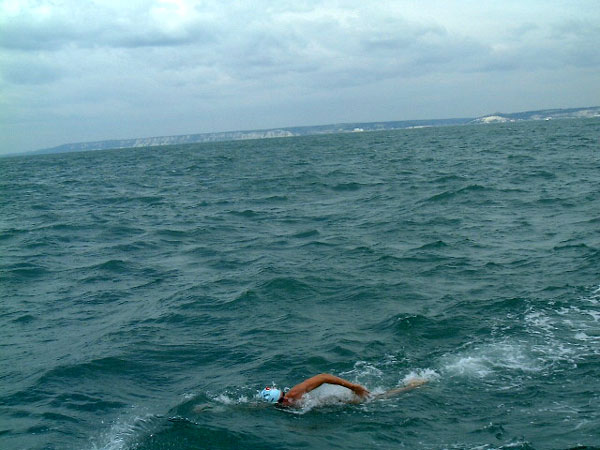 Swimming the English Channel is a challenge for both body and mind. For many swimmers it is too high a challenge for approximately 90 % of all athletes who set out do not complete their swim. Hollander and Acevedo, a committed swimmer who failed twice in this endeavour, conducted interviews with eight athletes who successfully crossed the Channel. The purpose of the study was to examine psychological characteristics and reflective meanings of these athletes. Of particular interest was how they prepared for the swim, which mental strategies they used to overcome difficulties and what tips they would give athletes who wanted to reach excellence. This study might be of interest to swimmers who plan an ultra long-distance race or who are into psychological aspects in endurance sports.
1. Introduction
When swimmers set out from the Shakespeare Cliffs in Dover (England) to cross the English Channel and reach Cap Gris Nez (France) after 34 kilometers (27 miles), they will most probably experience several obstacles like changing tides, hypothermia, and mental boredom. The physical and psychological responses to these obstacles will decide the potential for success of the swimmers. Against this background, Hollander and Acevedo, two sports scientists, sought to answer the following questions:- What describes best the cognitive orientation toward the Channel swim?
- How did the swimmers prepare physically (and mentally) for this swim?
- What mental strategies did they use to help them complete the swim?
- What did the swimmers experience while crossing the Channel?
- What does it mean to have swum the Channel?
- What tips would they give athletes to achieve excellence in open water swimming?
2. Methods
In order to answer these questions, Hollander and Acevedo recruited 8 swimmers who completed the English Channel crossing and interviewed them on two occasions. The sample included 3 males and 5 females. The mean age of the males was 42 years, and the ages ranged from 23 to 72. The mean age of the females was 29 years (range: 24 to 31 years). The sample represented swimmers with a wide variety of experience with the Channel swim: 2 athletes failed it on their first approach, and 3 athletes completed it before – at least two times and thirty-one times at the most.3. Results
The results of the interviews are rendered in the order in which the questions appear in the list above. Besides, in order to illustrate the findings, they are sporadically accompanied by quotes that better express the underlying ideas.3.1. Cognitive orientations ("mind sets")
The cognitive orientations that emerged from the interviews were certainty of completion (confidence) and mental toughness. The comment that best depicted these orientations was: "When you swim the Channel you've just got to channel your mind. … You're going to make it to the other side and nothing else is going to stop you."3.2. Physical preparation for the swim
What specific training procedures did the swimmers engage in to prepare for the distance, cold, and unique conditions of the Channel? Some of the procedures the swimmers mentioned included training in extreme conditions and weather, progressive mileage increases, and weight training. While many of these procedures are self-explanatory, some require clarification:- In order to be prepared for the extreme conditions and cold weather, that is strong currents, high waves, and cold water, some swimmers trained in specific places were the conditions tended to be even more extreme than in the English Channel. Other swimmers trained nights, or stayed in the open water as long as they could, that is until the time of the year when it started to get cold.
- Some swimmers practiced vomiting. The reason for this is that vomiting from too much ingestion of salt water paired with the undulation of waves and anxiety or panic is a distressing experience for many swimmers and critical to success.
- Urinating: "That is another thing you got to learn: to urinate in cold water. So I'd wear a lose suit and practice peeing."
3.3. Cognitive strategies during the swim
Among the most notable cognitive or mental strategies that the swimmers employed in order to persevere in the Channel were: compartmentalization of time and swimming distance, positive self-talk, attention control, and strategic dissociation.- Compartmentalization of time and swimming distance was a strategy that was used by many of the interviewed swimmers. It helped them to achieve a specific focus while engaging in the long repetitive physical task of swimming, particularly to brake up their thoughts into smaller and more manageable parts. Some partitioned the swim into thirds, others swimmers counted down the hours.
- Positive self-talk was represented in the following: "… when you step into the water you have to tell yourself a thousand times I can swim the Channel. I can swim the Channel. I can't tell you how many times over the past year, two years I have said that to myself."
- Attentional control techniques were employed by some swimmers to refocus physical pain and fears from the dark and cold environment of the Channel waters. There are times where you switch off your mind to what your body is screaming at you." – "Whenever I get scared, I just go back to my breathing and my stroke. I exhale the fears and push the fears away."
- Strategic dissociation was noted by some swimmers in the form of rhythmic singing. It helped them to distract themselves from physical pain or to overcome feelings of depression.
3.4. Phenomenological experiences during the swim
The experiences while swimming were delineated into beginning, middle, and ending experiences.- The beginning of the swim was described as exciting, relatively fun and easy.
- In the middle of the swim, many athletes found it difficult to stay mentally focused in the face of coping with seal life encounters (i. e., jellyfish) and «cold» pain, particularly in the arms, the neck, and the stomach. «Cold pain is different; it's difficult to explain. If you get cold, it gets deep and you know that's hard to recover from.» With mental problems and loneliness, too, the swimmers had to put up with. «As you get farther into the race your perception kind of narrows. You just kind of zone out as you get more tired. In the beginning you think about a lot of things. Later on, you don't really think anymore. … I don't remember too much of the last three hours—I just kind of swam.» – «You can get very depressed. Way out there it's very lonely and even though you've got a boat next to you … but it's just you in the water.» – «… the feeling you get is that you look at it (the French shoreline) and it looks a certain distance, you swim for an hour or two an you look again and it (France) looks the same distance.»
- Upon completion, the swimmers noted both positive and negative mood states: One the one hand, finishing can be euphoric for a goal has been achieved. On the other hand, it can also result in feelings of unfulfillment or depression. The reason for such feelings may be that the attainment of such a high goal has commanded many sacrifices in terms of personal time, time with significant others, or mental and physical energy. Once this arduous process is complete, feelings of void may arise.
3.5. Reflective meaning of successfully crossing the Channel
The swimmers were asked to reflect on how the English Channel crossing had affected their lives outside of the sport. Some swimmers noted greater self-confidence, an awareness of unlimited potential, and increased occupational effectiveness. These effects were primarily put forth by swimmers who attempted the Channel crossing for intrinsic motives, notably for overcoming a physical and mental obstacle. The reflective meaning for swimmers, however, who attempted to better their personal best or set a new record were of less "philosophical" nature, and based rather on the outcome in terms of their time or their ranking relative to other competitive open-water swimmers.
3.6. Tips for long-distance swimmers
At the end of the interview, the swimmers were asked if they had any suggestions for long-distance swimmers planning to cross the Channel or pursuing similar goals. Their suggestions can be summed up like this:
- Train in such a way as to approximate the conditions in the Channel. Train in colder water, practice feeding in rough seas, and be ready to encounter sea life, nausea, and urinating problems.
- Develop a strong «mind set» so that no matter what you feel like, you do not give up or stop.
- Remember to expect delays and be flexible regarding the day of the swim.
- Compartmentalize your swim into smaller sections to make it more manageable.
- Make sure the people in your boat are people you trust and are a positive influence during the swim.
- Work on strategies to manage the pain of cold water. Mental strategies are particularly important.
- Plan in advance where you will stay, how you will train, and what to do in case of emergencies, both while swimming and during preparation.
4. Concluding Remarks
In their concluding remarks, Holland and Acevedo (2000) comment on some of their findings:- Adjusting the quantity and quality of training in practice sessions, is an important preparatory measure. In the eyes of successful ultra long-distance swimmers, however, it is equally important to include specific preparatory behaviors in the training plan such as vomiting, urinating, and practicing in extremely cold and painful conditions.
- The practice of deliberate vomiting seems to be extreme in a traditional sport training model. However, the ability to cope with stomach problems is of utmost importance because vomiting affects many swimmers and is estimated to be the cause of approximately 80 % of all failed attempts to swim the Channel. Training to urinate may seem to be a rather extreme preparatory behavior, too, but it proved to be useful in this ultra-endurance swim.
- The study demonstrated that ultra-endurance swimmers experience both positive and negative emotions upon reaching the French shoreline. These findings are somewhat surprising, since in earlier investigations with endurance athletes no such negative feelings have emerged. Yet, for Hollander and Acevedo it is obvious that the attainment of a high goal for which an individual has made many sacrifices (e.g. in the family or working life) may entail a paradoxical joy and sorrow upon completion.
- The current study examined only successful completers of the Channel swim and, consequently, the results can at the most be representative of approximately 10 % of the entire population that attempts the swim.