
Pull-Buoys: Don’t Touch the Crutch - It Might Hurt Your Swimming Much!© Felix Gmünder |
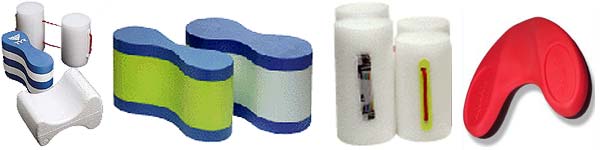
What are Pull Buoys recommended for?
Your body position in the water and your posture either make you more streamlined and faster, or they create drag and slow you down. In theory, the problem is easy to solve. In practice, it means understanding whether pull buoys are the solution to the problem.
Representative of the many that recommend pull buoys the following text is quoted: "They are light buoyant material and are placed between your thighs for arms only swimming. They are not only great for developing your shoulder/arm strength but since your legs are immobilized and supported, they help you to think about and focus on head/body position and hand/arm placement in the water. Use a pull buoy if you are have a tough time breathing and/or can only swim short distances. If you notice you are able to pull much faster than you can swim because the buoy elevates your legs into a streamlined position without any effort, then you need to re-evaluate your body position to reduce the drag from your legs during regular swimming."
This quotation is food for thought. Are you one of those people who prefer to use a pull buoy or a wetsuit when swimming freestyle or backstroke? Can you swim faster with a pull buoy than without? Is it more comfortable to breathe when you have the floating aid between your legs? Then, actually, you ought to work on your body and head position. The pull buoy acts as a crutch for the "disabled" swimmer, namely to compensate wrong body and head position. The only positive thing about pull buoys is that they show you how easy and fast you could swim if only your hips and legs would not sink, and you could breathe without fearing water coming into your airway.
In addition, pull buoys prevent you to learn how to initiate long axis body rotation with your kick.
Body Position
In the water two forces act on your body—gravity and buoyancy. A good swimmer exploits both forces so that she or he can minimize wasted energy for maintaining perfect balance and body position. On dry land there are 2 ideal body positions that minimize muscular effort and allow you to completely relax—either perfectly horizontal or standing straight upright. Anywhere in-between results in extra tension in some part of our bodies, more muscular effort and a higher energy cost and that is simply not efficient. In the water, while swimming freestyle and backstroke, we have to learn to exploit gravity and buoyancy to maintain a horizontal body position with the hips and legs at the surface. Kicking is meant to create propulsion and to support long axis body rotation, not to prevent them from sinking.
The Problem
Consider a torpedo—sleek, streamlined, fast—it slices through the water with very little waves and wake and with very little power required to propel it. Now, shift its center of mass behind the center of buoyancy or the center of buoyancy to the nose , the nose pops up and the tail hangs lower in the water. You know that it will slow down, leave a bigger wake and likely veer off course. Some of us swim this way. In swimming, head position is often the root of this problem.
Swimming an efficient freestyle (and backstroke) requires an elongated, horizontal body position, a body roll which allows a longer reach and provides for regular breathing without giving up the ideal body position. The problem is at first sight, rolling to the side when correctly balanced (horizontal) leaves our head underwater...where it's hard to breathe.
Most of us react to this uncomfortable feeling by lifting our heads to breathe. As a consequence our hips and legs drop well below the surface, negating our sleek, torpedo-like body position. Now, we're not horizontal and not relaxed either. Consequently, we can't swim as fast and we tire more quickly because we need part of the energy to overcome increased drag and to lift our head clear of the water.
The Solution
The solution is to learn how to breathe on our side without lifting our head, which makes the hip and legs sink. On this website you can find all the material to get familiar with this concept: Learn to Swim Freestyle More Efficiently
What should I do with my pull buoy?
Once you have learned proper balance and body position you should not use a pull buoy again. If, however, you are still in the steep part of the learning curve you might benefit using it from time to time to sharpen your kinesthetic sense of how it feels to have your hips and legs effortlessly supported and how that you can use your armpull to simply glide forward. Then try to replicate this sensation without the buoy (Front Quadrant Swimming).
Can I use a wetsuit?
Wetsuits were designed to keep you warm in cold water. As a side effect they instantly solve the balance problem and you can swim about 3-5 % faster if you are a average to bad swimmer. If you have to swim in cold water or if you participate to a triathlon where everybody wears one you should put it on of course. However, if you want to learn to learn to swim properly don't don it.
Is it useful to train with pull buoy, tube around the ankles, and paddles?
Some swimming teams use pull buoys in combination with tubes around their ankles (to increase resistance), and paddles as a means to specifically train arm and trunk muscles involved in generating propulsion. The load can be varied by the size if the paddles until anaerobic loads are reached. If you try to swim fast this training method is a combination of sprint-assisted and sprint-resisted training.
Coaches favouring this approach suggest that a stroke specific "strength training" is possible. They claim that swimming with paddles and increased resistance means training of the anaerobic metabolism in the muscle. One effect in "strength-trained" muscles is an increase in capillarization which perhaps has a small effect on endurance capacity purely by facilitating oxygen delivery to working muscles. Other coaches are sceptical about the tube. They argue that firstly, co-ordination of kick, pulling and body rotation is hampered, and that secondly, the danger of damaging your shoulders is substantial. These coaches combine sprint-assisted and sprint-resisted training by using fins and parachutes simultaneously (no paddles).
Supporters of both views stress that the training aids mentioned above are meant for elite swimmers only with proper swimming technique and a thorough physical background. By the way, there are very successful swimmers coming from both camps.