
What Is the Best Arm Stroke Pattern for the Front Crawl?© Felix Gmünder |
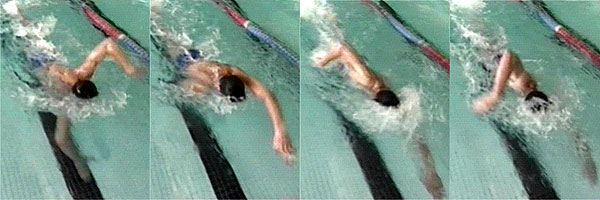
Swimming technique: Nothing new, really
Rhythm is one of the most important basic elements in any sport. In freestyle swimming, rhythm essentially means the coordination of kicking with the body roll, and with arm strokes as well timing of one arm with the other. Good rhythm results in fluent and elegant swimming that looks almost effortless.Basically swimming technique base specifications have not changed for 25 years. Swimming efficiency is based on minimal resistance and maximal propulsion. Good swimmers achieve this by a horizontal body position, maintaining a side-lying gliding position during most of the time of the stroke cycle, "front quadrant" timing of arm strokes, and high elbow position when they catch the water. Fast swimmers have excellent overall coordination.
Alexander Popov swims similar with respect to most aspects. His Coach Gennadi Touretski and Popov have modernised freestyle swimming since the early 1990ies. If you compare Popov's freestyle technique with the one of the Australian middle distance and distance swimmers, one of the most prominent difference you will note is related to the timing of the arms. Popov does not use "front quadrant" timing or "overlapping strokes". He applies a rotary armstroke pattern.
In the following article I try to explain to you the advantages and disadvantages of different timing patterns and what this means for you or your swimmers.
Timing of freestyle stroke: The three basic patterns
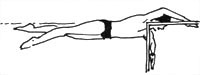
Source of pictures: Cecil Colwin, Swimming Technique
1) First, the typical right-angle timing of the arms is shown. This is the most commonly-used type of timing. As one arm enters, the opposite arm is midway through the stroke.
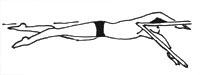
2) The second picture shows a timing in which the arms overlap in front of the swimmer (front-quadrant swimming). This type of timing is more commonly used by swimmers with natural buoyancy and balance, a strong leg action and a streamlined body build or position who slip through water easily. This type of timing is used more often by distance swimmers than by sprinters.
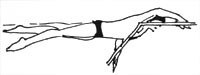
3) 3) In the third basic pattern, when one arm enters, the opposite arm has already passed the midway point of the pull (rotary stroke, s. sprinters shown in vedeoclips below). This timing suits swimmers who use bilateral breathing (once every three strokes) and two-beat leg action. It is most often found with sprinters, in particular those with a high turnover rate.
How is stroke efficiency measured in swimming?
- Stroke efficiency is defined by the distance covered per arm stroke or, as is easier to determine in practice, the number of arm strokes per length. Read the article Freestyle swimming: distance per stroke and efficiency".
- In the case of very good swimmers, the hand always breaks the surface of the water before the point of entry, sometimes even more than a metre before. This can be clearly seen from the side by watching the line.
Conclusions
- You can swim freestyle fast using different coordination patterns of your armstroke. Most distance swimmers use front quadrant swimming, whereas most sprinters prefer rotary armstroke.
- All swimmers rotate their body (hips and shoulders) along the longaxis so that they spend most of their time on their sides. They roll their body from one side to the other in a snappy movement using their kick (2 beat or 6 beat kicking pattern) and arms as anchors. The frontal anchor is either the catch or early pull phase.
- Which technique you prefer for yourself or your swimmers depends on many factors, mainly sprint/distance swimming, body shape, etc.
- It's important to think of how to reduce water resistance. Many swimmers concentrate on how to maximise propulsion. You can reduce resistance by maintaining a horizontal body position (hips at the surface) [Correct body position in freestyle swimming].
- To work on swimming technique you have to be warmed up but not tired. Usually you do that at the beginning of a work out. To practise swimming technique swim slowly to superslowly. Touretski says swimmers have to learn to "go for a walk in the water".