
Freestyle Swimming: Distance Per Stroke and Efficiency© Felix Gmünder |

Increasing Your Stroke Length Is the Key to Swimming Faster
In order to maintain or increase their swimming speed in the sub-maximal, aerobic zone, good swimmers generally increase their stroke length whilst maintaining a constant stroke rate.However, when the maximum lactate steady state is exceeded, stroke length decreases and stroke rate increases.
The maximum lactate steady state represents not only a physiological but also a biomechanical threshold, above which stroke length is compromised.
The reasons for the decrease in stroke length are thought to be fatigue and a lack of strength to swim at high speeds with a low stroke rate.
The authors recommend that coaches evaluate their swimmers’ stroke length and physiological parameters at high speeds. Swimmers should frequently swim at a slow pace with the aim of increasing stroke length. They should endeavour to maintain a constant stroke length at and above the maximum aerobic speed.
Source: Dekerle J, Nesi X, Lefevre T, Depretz S, Sidney M, Marchand FH, Pelayo P.: Stroking parameters in front crawl swimming and maximal lactate steady state speed. Int J Sports Med. 2005 Jan–Feb;26(1):53–8. In humans, swimming speed depends on stroke length and stroke rate. Stroke length refers to the distance the body is propelled forwards with one arm stroke cycle. Stroke rate refers to the number of arm stroke cycles per minute (B.G. Hay: Swimming biomechanics, a brief review. Swimming Technique 9:15–21 (1983).
As early as 1979, Craig and Pendergast (Med Sci Sports Exerc 11:278–283) demonstrated that swimmers can achieve a specific, predetermined swimming speed by varying either the stroke rate or the stroke length. However, these tests were only conducted over 25 yards; in other words, apart from in the region of maximum individual sprint speed, there were no metabolic limitations. Craig and Pendergast (1979) hypothesised that fatigue over longer distances manifests itself through a reduction in stroke length and, consequently, swimming speed. The quality of swimming technique depends not only on biomechanical factors, but also on physiological ones.
Dekerle et al. (2005) investigated precisely this question: whether and how stroke length changes over distances of 200 metres or more during the transition from the submaximal, aerobic range to the maximal range.
Dekerle et al. (2005) assumed that, close to maximum swimming speed, stroke length decreases due to fatigue or a lack of strength.
The speed at which a steady state of lactate is still established in the blood (VMLSS) was postulated as the threshold value for impairment of swimming technique. VMLSS is the modern concept for the anaerobic threshold.
3. Results
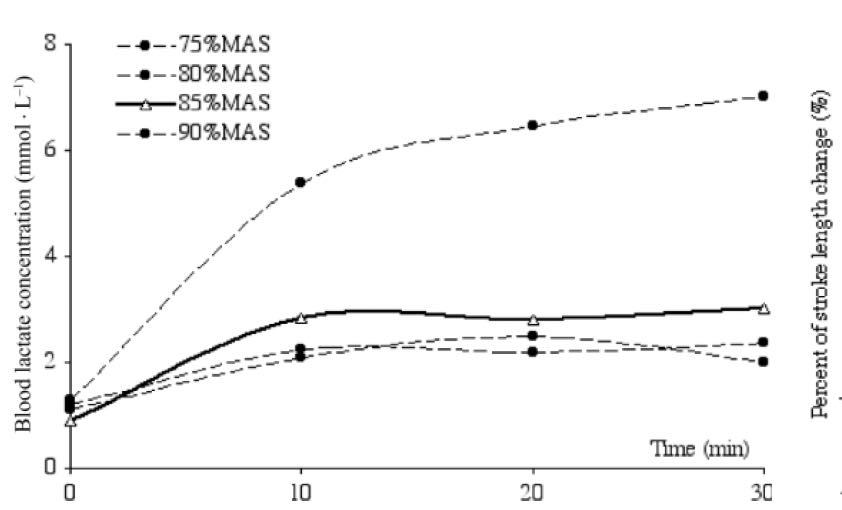 Figure 1 shows how the blood lactate concentration depends on swimming velocity. The swimmer shown has a SMLSS at 85% of his maximal aerobic speed.
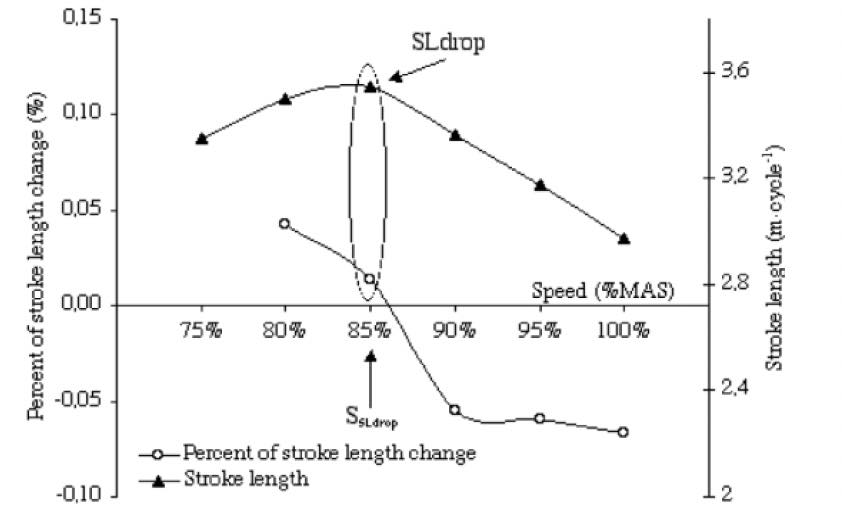 Figure 2 shows the dependence of stroke length (upper graph, right hand axis) and percent of stroke length change (lower graph, left hand axis) from swimming speed.
4. Conclusions and Recommendation
The most important finding is that the speed of maximal lactate steady state is almost identical to the velocity at which the stroke length starts to drop more markedly. This means that swimming faster than the personal SLMSS entails shorter stroke lengths. High stroke lengths can only be maintained for a prolonged time at slow, aerobic speeds.This observation goes in parallel with results found in other cyclic sports disciplines such as running or cycling where fatigue entails higher frequencies and/or shorter strides. For instance, 3000 m runner's strides get shorter during the last lap, even if the running speed does not change. Cyclists tend to choose faster cadences during races.
The authors recommend that coaches should examine stroke lengths and physiological parameters at high swimming speeds. Swimmers should take considerable time to swim at low speeds to improve their stroke lengths. They should try to keep the stroke length constant when swimming at maximal aerobic speed or above.