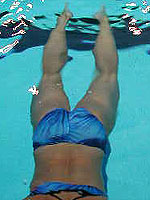
How Do You Do the Breaststroke Correctly??© Felix Gmünder |
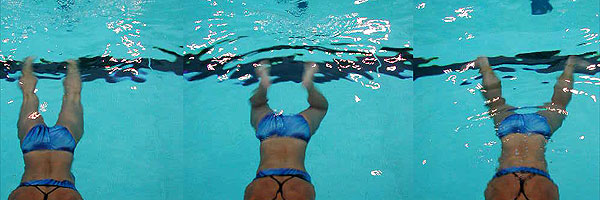
The breaststroke kick is technically demanding
Most world-class swimmers use the whip kick style which consists of a diagonal and semi-circular backsweep of the lower leg. The feet travel out, back, and then down until they come together.The primary propulsive force comes from the soles of the feet.
Good flexibility of the hip and ankle joints are required for a good breaststroke kick.
To describe the breaststroke kick we separate it into 5 phases:
- Recovery
- Catch
- Outsweep
- Insweep
- Leg lift and glide
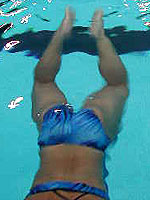
Photo 1: Recovery
Recovery consists of a knee and a hip flexion. The knee flexion starts when the propulsive phase of the armpull is finished (hands within shoulder width. Timing of whole stroke: Breaststroke Swimming). The lower leg is brought up and forward. The ankles are loose. Flexing the knees continues (s. following photos) until the arms are extended forward and the head and upper trunk sink. The hips have to drop during recovery to keep the legs under water without flexing the hips.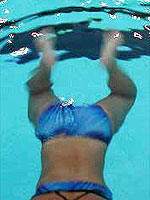
Photo 2: Recovery
Only when the arms are extended forward the hips start to flex to complete leg recovery as shown in photo 3.The hip flexion must not begin too early to avoid frontal resistance created by the thighs. Many swimmers flex their hips too early, too much or pull their thighs under the hips. Although the hip flexion will slow down the swimmer, it is essential to allow for greater force during the following propulsive phase.
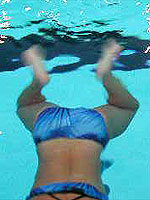
Photo 3: End of Recovery / Catch
Swimmers should separate the knees when they recover and not keep them together. This will enable them to hide the lower legs and feet inside the wake created by the body (less frontal resistance). They should not separate their knees more than shoulder width, however, unless they have sore knees or an injury to the knees (s. caption photo 3).When the feet approach the buttocks, swimmers should flex their feet at the ankles and rotate them out to initiate the catch.
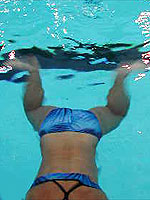
Photo 4: Catch / Outsweep
At the same time when the feet are flexed and turned out, the outsweep of the lower legs begins. Soles face backward against the water. This is the when the catch is made.Ideally, the outsweep of the feet starts without pushing back with them. This is called a high catch in analogy to the high elbow in the catch position of the arms.
The outsweep, the catch, and the first part of the insweep are the most stressful phases for the knee joint (i.e. the medial ligaments and menisci). As a remedy or to prevent sore knees, swimmers have two possibilities: firstly, they can reduce the width of the outsweep (less propulsive potential), and secondly, they can recover the legs with the knees spread slightly wider apart than shoulder width (increased frontal resistance).
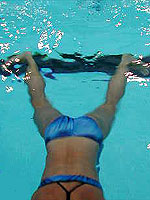
Photo 5: Insweep
The insweep is done with feet flexed and turned out. The soles push back in the beginning. Before completion of the insweep the feet are pitched inward.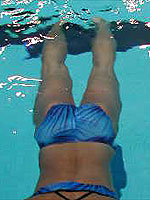
Photo 6: End of Insweep
The most common mistake during the completion of the insweep is to extend the feet at the ankles before the insweep ends. Swimmers should keep the feet flexed at the ankles and turned inward until the insweep is completed. If they don't, water is pushed up instead of back during the last phase of the insweep.