
Rehydration for Swimmers, Drinking in Swimming© Felix Gmünder |
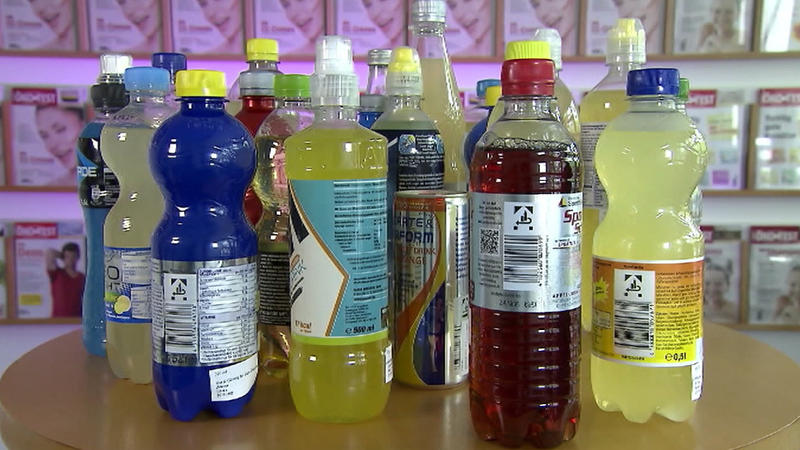
When you do sports you have to replenish loss of water
An athlete without a bottle is like a fish out of water. In some studios the bottle is part of the outfit.Motivation
Most if not all studies dealing with optimal rehydration include recommendations for long distance runners or triathletes and similar sports which exercise for more than about 60 minutes. This is not what swimmers are dealing with during competitions. However, it compares well with swimming workouts and long distance open water swimming.Introduction
If you run or swim long enough you need to replenish perspired water - in some cases you must drink a lot to keep your body working properly. During swimming you do not feel that you sweat. Fluid loss in the water can impair performance considerably, however!If you do not replenish your water reserves you get dehydrated. And this status is very bad for performance during training or competitions, and you will need longer to recover following exercise. This is what we know thanks to research in the field of sports nutrition and physiology.
The following figures and facts are based on a series of publications published by the Isostar Sports Foundation and two papers by Dr. F. Brouns of the Centre of Nutrition Research of the University Limburg at Maastricht, the Netherlands (Magglingen, October and November issues, 1996).
The conclusions for swimmers were drawn by the author of this article.
Figures and Facts
- Adults need about 2.5 litres water per day at rest under normal temperature conditions. 1.2 litres as fluid - the rest comes with the food.
- If more than about 2% of body weight is lost by perspiration it can be shown that performance is clearly reduced. If you weigh 50 kilograms this corresponds to 1 litre sweat.
- Jogging for about half an hour during a warm summer day can lead to a water loss of about half a liter. This is not considered to reduce performance.
- To loose more fluid you have to exercise more: Marathon runners are known to perspire up to 5 liters, a football (some call it soccer ;-)) can loose up to 3.5 litres during the 90 minutes game if the weather is hot.
- Rehydration or drinking fluid at the required rate can be a problem: The body is not able to absorb more than 400 to 800 ml per hour during exercise.
- It has been shown that drinking fluid in small amounts, i.e. 200 to 300 ml every half hour is optimal.
- Drinks containing 60 to 80 g carbohydrates per litre (i.e. isotonic) are more readily absorbed in the gut as compared to pure water (hypotonic) or soft drinks (cola, lemonade) and fruit juices (more than 100 g carbohydrates per l; hypertonic). Carbohydrates are, among others: White sugar (sucrose), glucose or dextrose, fructose, and maltodextrins (short chain sugars).
- Drinking cold drinks (but not ice cold and no ice, please) are an advantage when the weather is hot, it helps to cool the body. Cold drinks taste better, and this helps to drink faster and more. Some people cannot drink a lot of cold fluid at a time. So check it out during your workouts.
- In contrast, if the weather is cold drinking warm fluids helps to warm up a freezing body.
- Drinks containing carbohydrates, in particular sugars, provoke the rapid production and secretion of insulin by the pancreas. Insulin is a hormone that enables muscle cells to take up sugars from the bloodstream. This is the good thing. The bad thing is that the insulin peak will lead to a dramatic drop of sugar levels in the blood after 1 to 3 hours following sugar uptake which leads to increased tiredness and a drop in performance and mental concentration. However, if you are in a racing situation, ready to compete, this effect is annihilated.
- It is thought that you can hyperhydrate your body by drinking 300 to 500 ml immediately before you start exercising.
- Women perspire less than men
- Children sweat less before puberty as compared to teens and adults
- Children and small and thin persons cool loose more heat in the water as compared to adults or fat people. This is due to the low ratio of body weight to body surface.
- If you are well hydrated, urine is almost colorless, it has the color of diluted lemon juice, i.e. a very light yellow hue.
Conclusions for Swimmers
Conclusions have to consider the following situations in competitive swimming:- Training/Workout
- Swimming meet (pool)
- Long distance swimming (open water)
1 Training/Workout
If your workout lasts for less than half an hour you get dehydrated only if the water is very warm, or if the workout is very exhaustive and probably only if you are male. Before, during and following workouts it is advised to quench fluid losses using typical sports drinks (60 - 80 g carbohydrates and about 2 g salt per liter) - they foster fast absorption in the gut.Kids perspire less and loose more heat than adults, but their sense of thirst is less well developed as in adults.