
How to Plan Swimming Training© Felix Gmünder |
Focus on training planning for adult long-distance swimmers
I am often asked by swimmers who train on their own how they should plan their training and whether I have training plans. It is not easy to answer these questions without knowing their level and their goals. In most cases, these adult athletes either want to get or stay fit, or they are preparing for an open-water competition or a triathlon. In this article, I’ll focus on training planning for long-distance swimming, for example for triathlons or lake crossings.Training planning is only worthwhile if you train at least twice a week for an hour. From four training sessions a week onwards, it’s essential if you want to train with a view to improving your performance.
I start with:
- a short overview on the basics of training planning.
- Secondly, a reliable method to determine the lactate-steady-state and
- thirdly tips for distance swimming training are presented.
Training Planning
It is well known that only a few very disciplined swimmer can swim a monotonous training for a longer period of time. Careful planning works best to prevent boredom and performance barriers. Planning starts width the question what your goals are and for how long you plan to swim (how many years, e.g.).Whenever possible, fitness and long distance swimmers should join a team as often as their job or geographic situation allows. If you train mostly on your own, consider to write down a training plan. In the following I present the basics of training planning. For more information consult a book such as Emmett Hines's "Fitness Swimming" or Swimming Even Faster, by Ernest W. Maglischo. The essentials about training planning are as follows:
- Yearly planning, e.g. for the next 1 to 3 years, width increasing volume.
- Season planning, e.g. culminating in 1 or 2 important competitions per year.
- Cycle Planning, e.g. macrocycles of 4-12 weeks duration, mesocycles of 2-8 weeks, and the weekly microcycles.
Yearly planning. In relation to adaptation to training load and to prevent injuries it is advised that the yearly mileage and intensity increases gradually. The milage should not increase by more than around 30 percent per year.
Season planning. Most coaches divide the training year into 2 to 3 seasons. At the end of each season there usually is an important competition. The decision about whether to use 2 or 3 seasons is based more on the calendar of competitions than on physiological effectiveness.
Macrocycles. Macrocycles are major segments of a season. A long season of say 26 weeks can be structured into 5 macrocycles as follows: macrocycle #1: "general preparation period" 4 to 12 weeks, macrocycle #2: "specific preparation period" 4 to 8 weeks, macrocycle #3: "race preparation period" 4 to 6 weeks, macrocycle #4: taper period 2 to 4 weeks, and macrocycle #5: "competition and break 1 to 2 weeks. Salnikov's macrocycles consisted of 5 biweekly segments: #1 speed and technique, #2 strength, #3 aerobic endurance, #4 superadaptation, #5 meet and rest.
Mesocycles. Mesocycles are shorter phases widthin macrocycle. They can be of 2 to 8 weeks in length. Mesocycles should consider competitions, family, business, and educational commitments as well as holidays. In mesocycles the workload of the training can increase (e.g. stepwise in 3 weekly steps) or remain constant. It is followed by a recovery phase (e.g. the fourth and last week). Most experts believe that this succession of workload and recovery phase leads to the fastest increase in performance.
Microcycles. Microcycles are identical width weekly planning. It is essential for endurance swimmers that intensive trainings above the lactate steady state are not on successive days. Glycogen replacement may be incomplete. This is the most common mistake when developing basic endurance: Swimmers swim too often too fast because it is thought that only working hard makes you fast. When developing basic endurance every swimmer must swim at his or her specific pace below the maximum lactate steady state (don't race your training fellows).
Tips for endurance training program design
Because every swimmer swims different mileages per season, in the following season planning the percentage of the maximum milage is shown.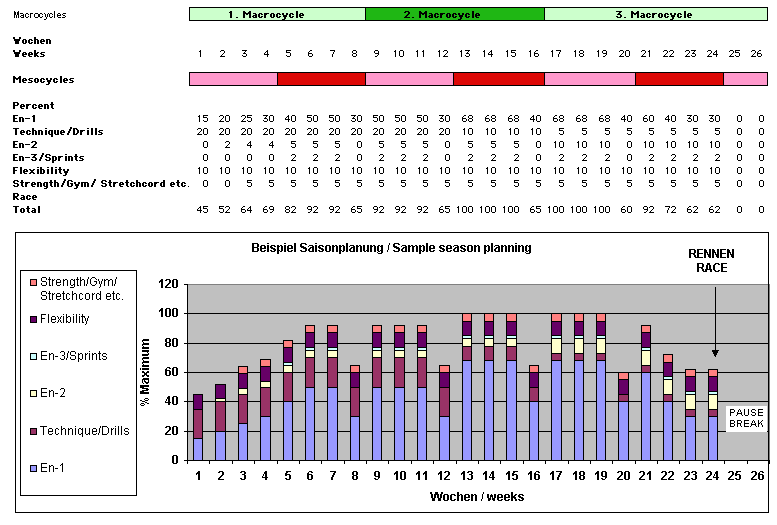
Figure 1. Sample seasonal planning for adult long distance swimmers (triathlon or masters). Explanation s. text.
Figure 1 shows a sample season planning for an adult distance swimmer. The season is 24 weeks long followed by a competition and a 2 week break. During the season, the milage increases gradually until it reaches 100 % of the maximum mileage. The season is divided into 3 macrocycles: General preparation, specific preparation, and competition/rest. Each macrocycle consists of 2 mesocycles of 4 weeks duration. At the end of each mesocycle there is a recovery week. The percentage of aerobic endurance (En-1 as well as a part of technique/drills) increases in the 2. macrocycle up to 70%. Threshold loads increase from 5 to 10% during the 3. macrocycle. The percentage of lactate producing training components (En-3 and sprints) is always a low 2%.
Lactate Steady State / Anaerobic Threshold
Lactate production was regarded as an indicator for anaerobic muscle metabolism (anaerobic glycogen metabolism). Working muscles produce lactate even at rest and at low power, i.e. when enough oxygen is available. Only above a certain "threshold" lactate starts to accumulate in the blood. Actually from the viewpoint of muscle physiology, the correct notion for muscle work in the aerobic range is "lactate steady state" (En-1). There is a transition zone ("Threshold") when lactate is just about to increase (En-2). If lactate accumulates clearly this is called the En-3 training zone.Endurance athletes should not always train in the En-1 zone. Small proportions of the mileage should be swam in the En-2 and even En-3-zone. This helps to better recruit fast twitch muscle fibres in addition to slow twitch fibres. If you train to often in the En-2- and En-3-zone this leads to a depletion of muscular glycogen reserves which is very harmful for endurance. Thus, do not swim more than 3 workouts per week in the transition or lactate accumulation zone.
Conclusions for unattached athletes
Because of the job or family situation for most unattached swimmers it is not possible to plan their training as carefully as they should. In contrast, for swimmers at the elite level this is essential. All swimmers have to keep in mind that some periodisation is helpful. A monotonous training pattern can become boring and you make no progress. In addition, experience shows that too many endurance athletes go to their limits too often and on successive days which depletes their muscle glycogen. Up to 70% of the mileage should be basic endurance i.e. below the maximum lactate steady state (or anaerobic threshold, s. below). This approach develops endurance best and at the same time it allows you to check your swimming technique.Monitoring Endurance Training
To develop endurance, athletes must train mostly below the maximum lactate steady state. In essence there are 3 methods to determine this steady state:- Blood testing of lactate: expensive and too demanding for unattached swimmers
- Heart rate monitoring (e.g. Conconitest): very unreliable or very demanding
- 30-minutes-test: easy and reproducible
Swimming speeds below the steady state develops basic endurance (En-1), speeds at the transition zone develop En-2, and speeds definitively faster are known as overload endurance (En-3). To set up a training plan every endurance athlete must find the right mix for every training period.
Tips for distance swimming training
In essence, there are two methods to improve endurance (En-1, En-2, and En-3):- Repeat sets (Interval training)
- Distance swimming
Repeat Sets (Interval Training)
The following four parameters can be varied when swimming repeat sets:- Total length of repeat set
- Interval
- Repeat distance
- Swimming speed
Table 1. Effect of Repeat Set Design on endurance training. slow = lactate steady state, moderate = transition zone, fast = lactate accumulation zone
| Parameters | En-1 | En-2 | En3 |
|---|---|---|---|
| Length | > 10 min | 20-15 min | 15-20 min |
| Interval 50-200 m | 5-10 sec | 5-10 sec | 20-30 sec |
| Interval >400 m | 5-20 sec | 1 min | 1-3 min |
| Distance | > 50 m | > 200 m | > 50 m |
| Speed | slow | medium | fast |
In addition, it is possible to swim successive repeat sets width descending rest. For instance, swim 3 x 8 x 100 m. In the first set the interval is 1:45, in the second set 1:40 and in the third set 1:35. width descending interval you are forced to swim faster which means you start swimming in the steady-state zone and end up in the transition or lactate accumulation zone.
Distance Swimming
In addition to repeat sets you have the following choices to improve your swimming endurance: "Marathon swimming" and "Fartlek". The advantage of these training forms is that you don't unaccidentally train in the transition or lactate accumulation zone. The drawback is that these training forms can be boring.Marathon swimming. Minimum time is 15 minutes. Swim at an even pace below the "threshold".
Fartlek. Swedish: "Speedplay". Long distances (> 400 m) are divided into shorter, successive distances that are swum at different speed (slow / fast). Depending on the setup you can put the emphasis more on En-1, En-2, or En-3, respectively.
Table 2. Examples of Fartlek training.
| En-1 | 1 hr: 200 m slow - 100 m fast |
| En-1 | 2 km: 100 m fast - 100 m slow (you can change the stroke) |
| En-2 | 30 min: 150 m back - 50 m easy |
| En-2 | 1 km: 75 m fast - 25 m drills |
| En-3 | 1 km: 25 m sprint - 75 m easy or drill |