
Swim Faster With Good Posture and Floating© Felix Gmünder |
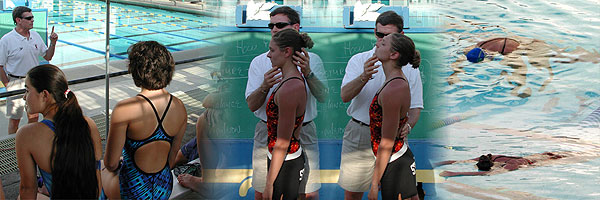
US coach Richard Quick explains how to reduce drag
Swimming fast means keeping drag as low as possible in the first place. You can reduce resistance by good posture and balance in the water. Increasing power has second priority to reducing drag. Richard Quick, one of the best US-coaches, explains to us why and how you can achieve this. Richard Quick was headcoach of Stanford Women's Swimming, one of the most successful NCAA-teams. The tips given were presented during a swim clinic for the Punahou Swimming Team in Honolulu, Hawai'i.
How important is water resistance in swimming?
Drag increases with the power of two with swimming speed. The required power a swimmer has to develop in order to increase speed increases to the power of three. This means that every swimmer soon reaches a point where improving the arm pull and kick results in almost no gain in swimming speed. You get the feel of swimming against a wall. You can improve your velocity by making your body as hydrodynamic as possible by good posture and balance, and by keeping them in the optimal range throughout a swimming cycle (stay "in line").What is the significance of posture?
Lacey Boutwell shows posture with high and low water resistance (images to the left and right, respectively).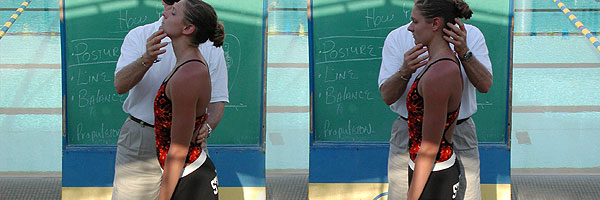
The characteristics of high resistance posture are high head position (looking forward when swimming) and arch of the lower back (lordosis). Keep your head in the same line as the spine.
When you breathe in breaststroke and butterfly try to keep this head position. In backstroke the nose should always point straight up. In freestyle the nose is up during breathing (in a side-lying gliding position), then back under.
Avoid the arch in the lower back by tilting the top of the pelvis backwards (image to the right). This can be practiced by pressing the lower back against a wall. Check if all your back touches the wall. Look straight forward. If you can raise your arms above your head (as if pushing from the wall after a turn) and touch the wall, all the better (this requires good shoulder flexibility).
Position in the water: You need to be able to float in the water
Increasingly better balance (from the left to the right).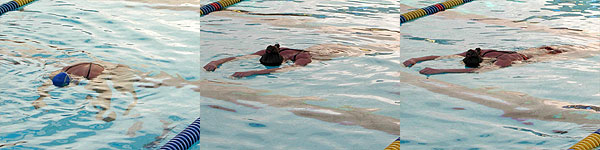
Good balance requires that you can float in the water, on your stomach as well as on your back.
On your stomach try to make your body as long as possible, in order to keep optimal form. To do that, your chest acts as the buoy that makes your body float. To transfer this buoyancy to the rest of the body, gently press your chest into the water. Don't thrust your chin forward. Tip: try to elongate your neck and make a double chin. Again good shoulder flexibility is a big advantage (s. image to the right). Your buttocks and if possible your feet should float at the surface. If they sink, keep the body stretched and tilt the top of the pelvis back. Floating on your back is easier. This balanced, horizontal floating position represents the basic body position in the water for all four strokes.