
Can You Lose Weight by Swimming?© Felix Gmünder |
Success depends on the intensity, duration and frequency of the training sessions
Some people still claim that swimming or exercising in water is not as efficient in controlling or loosing weight as compared to exercising on land. This statement is based on obsolete research published in the 1980ies (e.g. Gwinup, G. (1987): Weight loss without dietary restriction: Efficacy of different forms of aerobic exercise. American Journal of Sports Medicine, 15, 275-279).Recent studies show that, when it comes to successful weight management, it doesn’t matter whether you exercise on land or in water, but only how intensely, for how long and how often you exercise.
In this study, for example, the effect of three different exercise protocols on body composition parameters was compared. The training lasted for 13 weeks. (Gappmeier E. et al.: Aerobic exercise in water versus walking on land: effects on indices of fat reduction and weight loss of obese women. J. Sports Phys Fitness 2006; 46, 564-9).
The exercise programme was of relatively high intensity, namely about 70% of the maximal age-related heart rate ([220 minus age] x 0.7). The first training lasted for 10 minutes. With every training the duration was increased by 5 minutes until at the beginning of the third week a 40 minutes duration for each session was reached.
The participants had to observe a standardised diet with restrictions on amounts of fat and refined carbohydrate, but not on caloric intake.
The results shown in Table 1 are discussed below.
 Table 1. Summary of mean losses in body composition parameters and mean increases in VO2max (including standard deviations. WL: Walking on land, SW: Swimming in water of 27°C, WW: Walking in water of 29°C. Reference: Gappmeier et al. (2006).
The results suggest that in terms of beneficial effects on body composition, there is no difference between aerobic exercise on land and in water as long as intensity, duration and frequency of workouts are comparable.
By the way: swimming in cold water makes you hungry – it doesn’t help you lose weight.
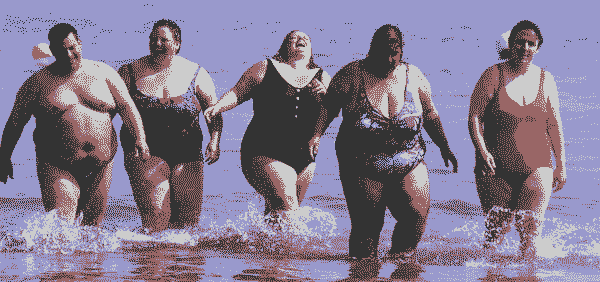
Overweight and obese persons often cannot exercise on land with the necessary intensity and duration, because the load can cause musculoskeletal problems. Some might be shy to expose their bodies on land to the view of others. In the water, these obstacles are not relevant.
However, swimming as the exclusive sport could be problematic, because the small load on the skeleton is not favourable to prevent osteoporosis [Which Lifetime Sport is Best?]. Nevertheless, it is always the better choice to swim than to become a couch potato.